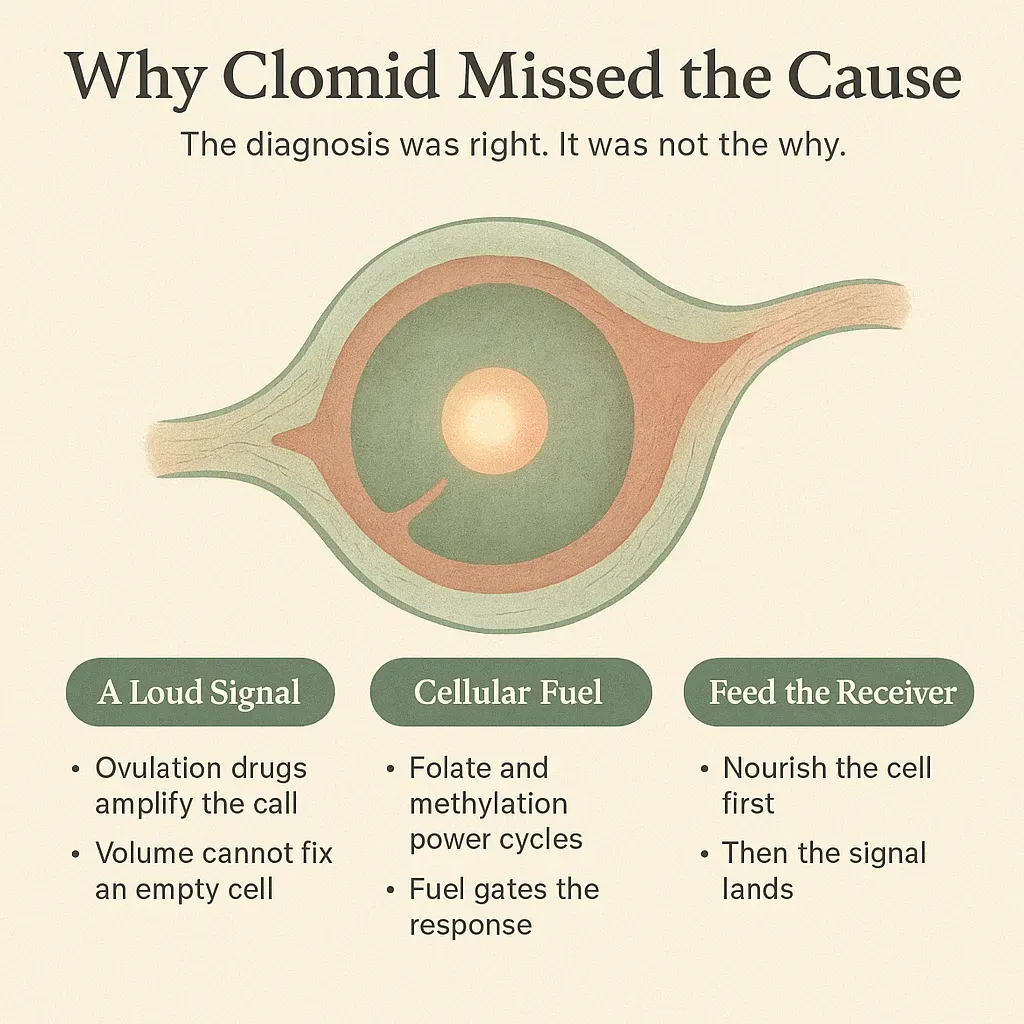
PCOS Anovulation: Why Clomid Missed the Cause
Clinical Review by Dr. Angela Sinnett, L.Ac
Vivian, 34, had done everything a PCOS diagnosis is supposed to ask of a person, and her body still would not ovulate on its own. What finally changed things was not a third round of the same two drugs her doctors kept reaching for. It was a panel of over 200 biomarkers that found the actual reason her cycles refused to cooperate, a reason with nothing to do with willpower, weight, or how "textbook" her diagnosis looked on paper. Vivian, based in Madison, Wisconsin, lives with a PCOS diagnosis she has never had reason to question: irregular cycles, confirmed anovulation, two rounds of standard ovulation-induction drugs. What she never got was an answer to why neither drug actually fixed it.
Two Failed Drugs, and a Question Nobody Asked
By the time Vivian found Strategic Fertility, "PCOS" had stopped feeling like an explanation and started feeling like a wall. She had the diagnosis in writing. She had the irregular, stretched-out cycles that could run six, seven, sometimes eight weeks apart. She had the anovulation, months where her body simply never released an egg at all, confirmed on bloodwork more than once. None of that was in question. What was in question, though nobody on her care team seemed to be asking it, was why. Her doctors did what conventional PCOS treatment almost always does first: they reached for Clomid, then, when that didn't work, Letrozole. Both are ovulation-induction drugs, and both are reasonable first steps on paper. For Vivian, neither one worked, and both came with a cost she hadn't been warned about clearly enough: weeks of severe mood swings that left her feeling like a stranger in her own home, on top of cycles that still refused to ovulate. She described it later as being handed the same key twice, being told to try harder to turn it, when the actual problem was that it was the wrong key for her particular lock There was a quieter cost too, one that rarely makes it into a clinical chart. Vivian had spent months tracking her own cycles on an app, learning the shorthand of her own irregularity so well she could predict, almost to the week, when a cycle would stretch past six weeks with no ovulation to show for it. She had read enough about PCOS to know the standard talking points by heart: lose weight, manage stress, try the next medication. None of it addressed the actual question sitting underneath her diagnosis, which was never whether she had PCOS. She already knew that. The question was why, specifically in her own body, ovulation kept failing to happen even when a drug was pushing the signal harder. That distinction, between a treatment that is supposed to work and a treatment that is aimed at the wrong mechanism entirely, is the reason this case exists. It is also the reason her mood swings on Clomid and Letrozole mattered clinically, not just personally. A body under that much added strain, with no improvement to show for it, is usually a body being asked to do something it does not currently have the resources to do.
Seed and Soil: Why "Induce Ovulation" Isn't the Same as "Fix Ovulation"
Clomid and Letrozole both work by nudging the brain's signal to the ovaries, essentially turning up the volume on the hormonal instruction to release an egg. That approach makes sense if the ovary is a healthy seed sitting in depleted soil, waiting for a stronger signal to grow. It does nothing if the problem is the soil itself, meaning the cellular machinery an egg actually needs to mature and release on schedule. An ovulatory cycle is not just a hormone signal arriving on time. It is a cellular event that has to be fueled, and it has to be protected from damage while it happens. Fueling it is the job of the mitochondria, the structures inside nearly every cell that run the Krebs cycle, the process that converts nutrients into usable cellular energy. Protecting it is the job of antioxidants like glutathione, which mop up the oxidative stress that a maturing egg cell generates as a normal part of its own development. And underneath both of those processes sits methylation, a chemical process that depends on adequate, usable folate, which helps regulate everything from hormone metabolism to the genetic material inside a developing egg. Louder ovulation signals cannot fix a soil problem. If the cellular energy supply is starved, or the antioxidant defense is depleted, or the folate pathway is blocked, the egg still will not mature and release reliably, no matter how many times the brain is told to try again. Vivian's two failed drug cycles were not a sign that her body was uncooperative. They were a sign that nobody had yet looked at the soil. It is worth sitting with why that gap exists in the first place. A standard PCOS workup is built to confirm the diagnosis, not to investigate the machinery underneath it. Once the diagnostic boxes are checked, ovulation-induction becomes the default next step almost automatically, because it is the treatment the diagnosis is built to trigger. Nobody along the way was acting carelessly with Vivian's care. The standard workup simply was not designed to ask a cellular-energy question, so it never did.
The Diagnostic Blueprint: What 200+ Biomarkers Found
Vivian's panel of over 200 biomarkers surfaced three specific, connected findings, each one a direct answer to a different piece of the seed-and-soil problem above. The first was a severe folate metabolism block. Her body was not efficiently converting folate into its usable, active form, the form methylation actually depends on. This matters for PCOS specifically because impaired methylation has been tied to disrupted hormone metabolism and, in Vivian's case, to a cycle that never built the signal strength to trigger ovulation on schedule. The second was critical glutathione depletion. Glutathione is the body's primary internal antioxidant, and a maturing egg needs it on hand to withstand the oxidative stress of its own development. With her glutathione reserves running critically low, Vivian's body had far less capacity to protect an egg through the final stages of maturation, one more reason ovulation kept stalling out even when a drug was pushing the hormonal signal harder. The third, and the one that tied the other two together, was mitochondrial Krebs cycle inefficiency, in plain terms, a body running on a starved cellular energy supply. This is the finding that reframed everything for Vivian. Her fatigue, her stalled cycles, and her mood swings on Clomid and Letrozole were not separate problems. They were downstream symptoms of the same underlying issue, a body that did not have enough usable cellular energy to run its own reproductive system efficiently, let alone absorb the added metabolic demand of a stimulating drug. Seen together, the three findings told a single, coherent story rather than three unrelated lab flags. A body low on usable cellular energy struggles to fuel egg maturation. That same body, once its antioxidant reserves are depleted, struggles to protect that maturing egg from ordinary developmental stress. And a body with an impaired methylation pathway struggles to regulate the hormonal signaling that is supposed to coordinate the whole process in the first place. None of these three findings caused Vivian's PCOS. All three explained, specifically and individually, why her PCOS kept resisting the standard next step. Individualized medicine matters here for a very concrete reason. Clomid and Letrozole are not one-size-fits-all "helpers," and they were never designed to be. They work well for some patients and not at all for others, and the difference usually comes down to whether the underlying cellular machinery was ever equipped to respond to a louder signal in the first place. Vivian's case is not evidence that those drugs don't work. It is evidence that a drug aimed at signal strength cannot resolve a problem rooted in cellular energy production, antioxidant capacity, and methylation. Her protocol had to be built from her own 200+ biomarker findings, not from the next line on a standard treatment ladder. Curious how a 200+ biomarker panel finds root causes that standard three-hormone bloodwork misses entirely? Dr. Angela Sinnett walks through the exact framework in a free masterclass.
The Four-Step Custom Protocol
Working directly from her own findings, Vivian's protocol targeted each piece of the soil problem at once, not one hormone signal in isolation. 1. Bioavailable methylated folate (L-methylfolate). Rather than standard folic acid, which her body was not efficiently converting, this delivered folate in the already-active form her methylation pathway could use immediately. 2. Liposomal glutathione. A highly absorbable delivery form chosen specifically to rebuild her depleted antioxidant reserves, restoring the protective capacity a maturing egg needs during its final development. 3. Mitochondrial Krebs cycle co-factors. Targeted nutrient support for the exact cellular energy pathway her biomarkers flagged as inefficient, addressing the fatigue and the stalled reproductive signaling at their actual source. 4. Insulin signaling stabilization. Since insulin resistance is a well-documented driver of anovulation in PCOS, this step supported steadier blood sugar and insulin response, easing one more pressure point working against regular ovulation. Vivian started this protocol already exhausted by two failed attempts and the mood swings that had come with them. She was not expecting a fast answer. What actually happened was faster than anyone on her care team, including her own doctors, would have predicted: she conceived within two weeks of starting her custom protocol. Not two cycles. Two weeks. The same body that had gone months without ovulating on two different stimulating drugs did, on its own, what it had been fully capable of doing all along, the moment its actual cellular deficits were addressed directly. This does not mean every case resolves in two weeks, and it should not be read as a promise of speed. What it does mean is that when a root cause is genuinely individualized, addressing it directly can work faster than escalating the same category of treatment ever could, because the treatment is no longer working against the body's own limitations.
Clinical Checklist: 5 Questions to Ask Before Another Procedure
1. Has anything beyond standard hormone bloodwork looked at cellular energy production, specifically mitochondrial and Krebs cycle function?
2. Has folate metabolism been tested directly, rather than assumed adequate because a multivitamin includes folic acid?
3. Has glutathione or overall antioxidant capacity ever been measured, given how directly it affects egg maturation?
4. If a prior ovulation-induction drug failed, has anyone investigated why it failed, rather than moving straight to the next drug in the same category? 5. Has insulin signaling been evaluated as a specific, treatable driver of anovulation, rather than folded into a general PCOS label with no individualized plan attached?
Frequently Asked Questions
Why did Clomid and Letrozole fail if Vivian's diagnosis of PCOS was accurate?
Both drugs work by strengthening the hormonal signal to ovulate. Vivian's diagnosis was correct, but her actual block was cellular: an underlying folate metabolism issue, depleted glutathione, and mitochondrial Krebs cycle inefficiency, none of which a stronger hormone signal alone can resolve. What is a 200+ biomarker panel, and how is it different from standard PCOS bloodwork?
Standard PCOS workups typically check a small handful of reproductive hormones. A 200+ biomarker panel looks far more broadly, including methylation markers, antioxidant status, and mitochondrial function markers, the exact categories that surfaced Vivian's actual root causes. Is mitochondrial or cellular energy dysfunction common in PCOS?
It is an increasingly documented piece of PCOS physiology, though it is rarely tested for in a standard workup. Vivian's case is one concrete example of what that specific gap can look like in practice. Does this mean Clomid and Letrozole don't work?
No. They are legitimate, well-studied treatments that work well for many patients. Vivian's case shows that they are not universal "helpers," and that when they fail, the more useful next question is why, not simply which stronger drug to try next. How fast can a root-cause protocol actually work?
It varies significantly by patient and by how many separate mechanisms are involved. Vivian's two-week timeline reflects her own specific biology and should be read as a demonstration of what addressing a real root cause can do, not a guaranteed timeline for any other case. For years, Vivian had been told, in effect, that her body needed convincing. What her 200+ biomarker panel found was that her body needed fuel, protection, and a metabolic pathway that actually worked, not another push on a signal it was never failing to receive in the first place. Individualized medicine note: every root cause named in this article, folate metabolism, glutathione depletion, mitochondrial Krebs cycle inefficiency, and insulin signaling, reflects Vivian's own documented biomarker findings. A different patient with a PCOS diagnosis could have an entirely different underlying picture. This case study describes what worked for her specific biology, not a universal protocol. Ready to find out what your own body's biomarkers are actually telling you?
Book a $37 Discovery Call with Strategic Fertility.