The Cycle That Never Came: How Molly Fixed Her Blood Sugar and Conceived at 32
Clinical Review by Dr. Angela Sinnett, L.Ac
For more than a year, Molly's body simply skipped the part of being a woman she had always counted on. She was 32, living in Peoria, Illinois, and her menstrual cycle had been gone for over twelve months. In its place came blood sugar swings severe enough to fog her vision by mid afternoon, crash her energy before dinner, and leave her lying awake at 2 AM wondering whether her body had quietly closed the door on motherhood without telling her. Her OB/GYN ran the standard PCOS playbook: a three hormone panel, an ultrasound, a conversation about losing weight, and a prescription for birth control to force a bleed. Nobody explained why her cycles disappeared. Nobody mentioned her blood sugar at all.
Then a single 200+ biomarker evaluation connected what three doctors had treated as separate problems: insulin resistance was stalling her follicles' development, while her elevated free testosterone was converting into excess estrogens that further disrupted the hormone rhythm keeping her cycle shut down. Five months into a protocol built around inositol therapy, chromium, and blood sugar stabilization, Molly's menstrual cycle returned on its own. At month 6, she conceived naturally. No stimulation drugs, no retrieval schedule, no forced bleed. Her body had never been infertile. It had been starving for the one investigation that connected her sugar to her ovaries.
One patient's story, with details changed to protect her privacy. Individual results vary, and no honest practice can guarantee an outcome.
Seed and Soil: Why PCOS Treatment Keeps Missing the Point
Conventional PCOS care is built around a single move: force ovulation. If the cycle will not come on its own, induce it with progestin pills. If a pregnancy is wanted, push the ovaries with stimulation drugs and hope a follicle ruptures. The entire framework treats the ovary as a stubborn machine that needs to be jump started, over and over, on demand. What it does not treat is the environment those follicles are trying to grow in.
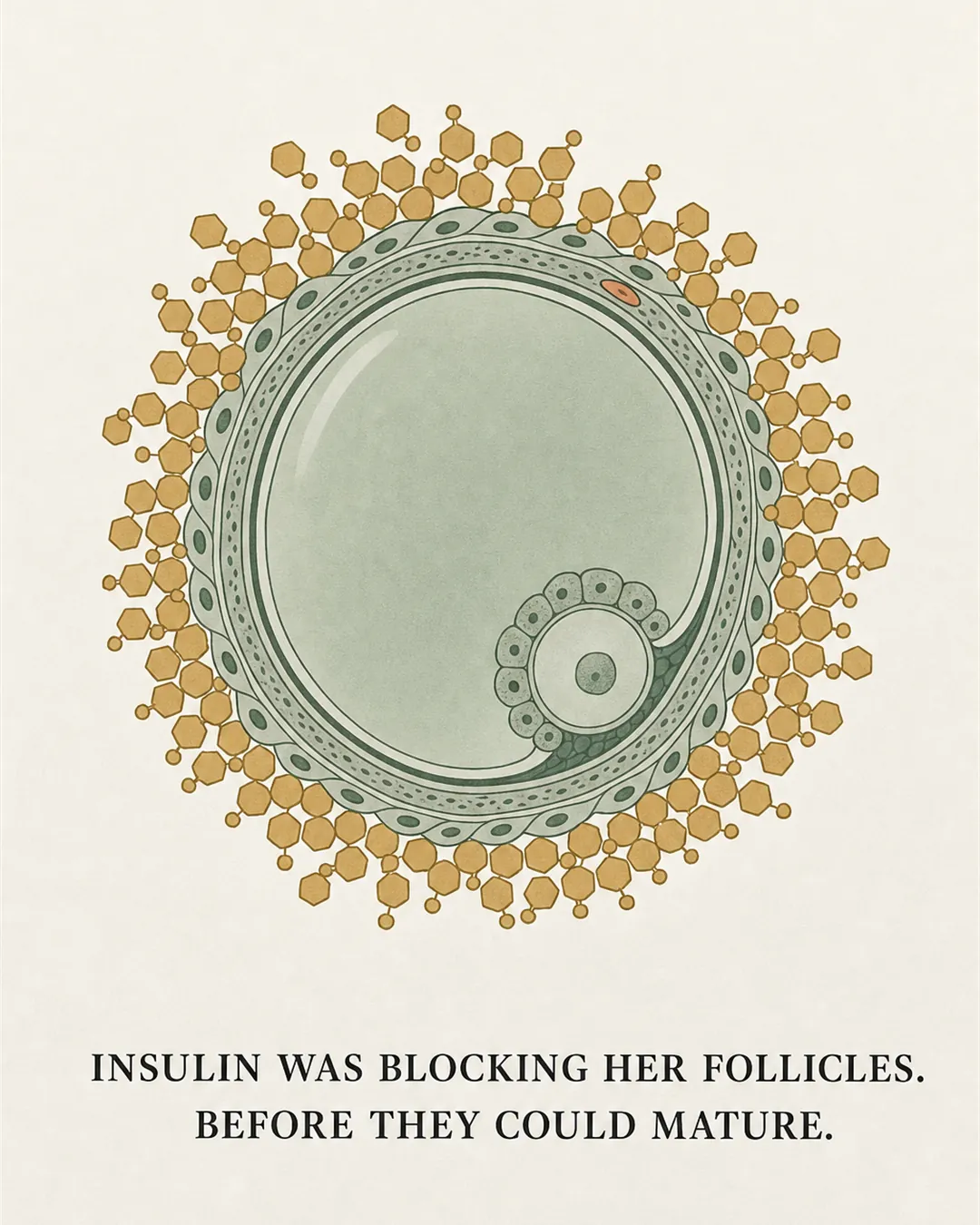
Here is what the standard playbook rarely explains: a developing follicle is one of the most metabolically demanding projects the female body undertakes each month. It requires a precise insulin and glucose environment to recruit, mature, and release an egg. When insulin levels stay chronically elevated, the ovary reads the signal as danger. Follicular development stalls partway, ovulation never arrives, and the cycle quietly disappears. This is why so many women with PCOS do not merely have irregular cycles. They have no cycles at all, sometimes for years.
Molly's case made the disconnect unmistakable. Her blood sugar swings were not a side issue to be managed by a diet pamphlet. They were the main event, the upstream force shutting down her reproductive rhythm. Yet her care had been fragmented across three separate conversations: a gynecologist for the missing period, a general practitioner for the sugar crashes, and a search history full of weight loss advice that treated her like a willpower problem instead of a chemistry problem. Nobody had ever run the test that connects the pancreas to the ovary, so nobody could see that her infertility and her blood sugar were the same story.
This is the soil blindness that repeats across nearly every PCOS journey we review. The seed gets all the attention: stimulate it, retrieve it, force it. The soil, the insulin and glucose environment every follicle must marinate in for 90 or more days before ovulation, goes unexamined. A follicle cannot mature in a metabolic flood any more than a seedling can take root in standing water. You can push the seed all you want. Until you drain the field, nothing grows.
The Diagnostic Blueprint: Two Findings Nobody Had Named
When Molly came to Strategic Fertility, our clinical team did not rerun her three hormone panel. We initiated a full diagnostic investigation analyzing over 200 biomarkers across 16 interconnected systems, with specific attention to the glucose, insulin, and androgen patterns her previous workups had skipped. Two findings reorganized her entire story.
First: insulin resistance was actively stalling follicular development. Her fasting glucose looked ordinary enough to slip past a standard screen, but her deeper metabolic markers showed insulin levels high enough to interfere with the follicle recruitment process itself. This is the mechanism behind her amenorrhea that no ultrasound had ever explained. Her ovaries were not failing to respond to force. They were responding correctly to an environment that read as unsafe for releasing an egg. Her severe mid afternoon crashes, the shakiness, the fog, were the same finding announcing itself in a language her doctors had not been listening to.
The ones specific to your body only get answered one way.
Book a Discovery CallWatch the Free Class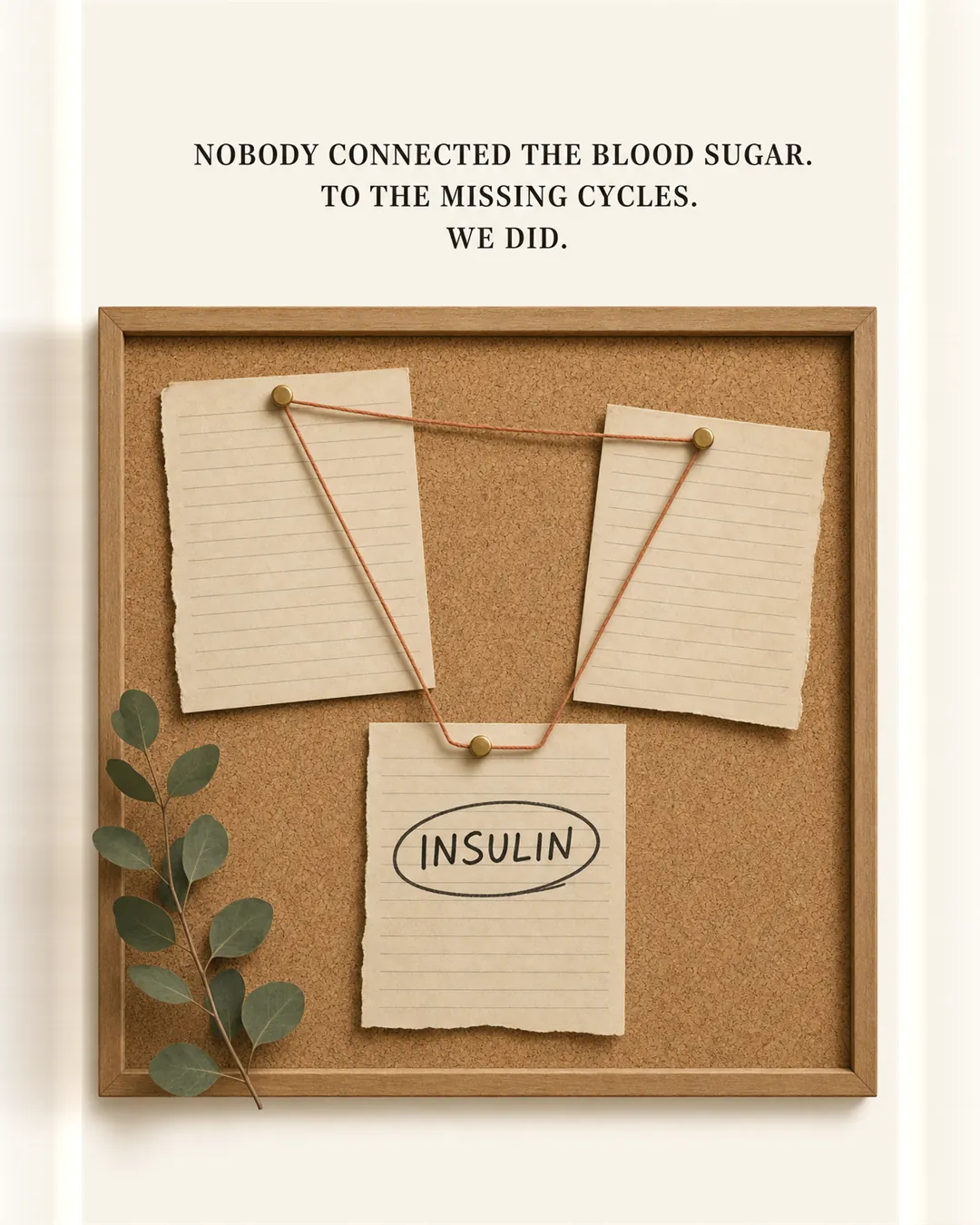
Second: her elevated free testosterone was converting into excess estrogens. In a balanced system, testosterone contributes to healthy follicle recruitment. In Molly's system, the surplus was converting into estrogens that further disrupted the delicate hormone rhythm required for a cycle to arrive at all. This created the classic PCOS trap: the hormone imbalance was not just a symptom of the insulin problem, it had become its own secondary engine, feeding back into the suppression of her cycle. Two findings, one connected loop, and neither had ever appeared on a lab report with her name on it.
Laid side by side, the picture stopped looking like a mysterious ovarian condition and started looking like a metabolic lock on reproduction. That raised the question her previous care had never paused to ask: if insulin signaling and the estrogen conversion loop were the lock, could a targeted, blood sugar centered protocol open it naturally in a 32 year old body, without ever reaching for stimulation drugs?
Are you wondering what a workup that actually connects these dots would show for your own body? In her free 30 minute masterclass, Dr. Angela Sinnett walks through the five core pillars of Strategic Fertility and shows how 200+ biomarker investigations uncover the hidden bottlenecks standard fertility care overlooks. Click here to watch the free masterclass: How to Reset Your Fertility Environment After 35
The Protocol: Rebuilding the Environment, Not Forcing the Ovary
Molly's protocol was designed against her own findings, not against a general PCOS template. It moved in four coordinated steps.
Step 1: Inositol Therapy to Restore Ovarian Signaling
The foundation was therapeutic inositol, the nutrient that functions as an insulin signaling mediator inside the ovary. In women with insulin resistant PCOS, inositol supplementation helps restore the ovary's own sensitivity to insulin's messages, allowing follicle recruitment to resume at the local cellular level. Molly began a structured inositol regimen in the doses and ratio matched to her panel, not a generic powder scoop from a wellness aisle.
Step 2: Chromium and Blood Sugar Stabilization
Alongside the inositol, we introduced targeted chromium support for its role in healthy glucose metabolism, paired with a deliberate eating structure built to flatten her glucose curve: protein anchored breakfasts within an hour of waking, balanced meals that paired carbohydrates with fiber and fat, and an end to the long fasting stretches that were feeding her rebound crashes. Within weeks, the mid afternoon fog that had defined her afternoons began to lift. Her blood sugar stopped swinging, and with it, the loudest upstream signal keeping her ovaries shut down began to quiet.
Step 3: Metabolic Lifestyle Rhythm
Hormones run on rhythm. Molly's protocol included a structured daily pattern designed to reinforce insulin sensitivity: post meal walks to clear glucose, consistent sleep and wake times to protect overnight metabolic repair, and morning light exposure to anchor her endocrine clock. None of these were lifestyle decorations. Each one was selected because it directly improves the insulin environment her follicles needed to complete development.
Step 4: Monitored Reassessment as Her Cycle Returned
As her biomarkers shifted, the team tracked her progress against repeat testing rather than guesswork, adjusting support as her body recovered its own rhythm. This is where individualized medicine stops being a slogan: every input in Molly's protocol was matched to a measured finding from her own 200+ biomarker panel. Another patient with PCOS shaped by a different pattern, perhaps thyroid driven, perhaps adrenal driven, could require an entirely different protocol. Restoring fertility is not about applying a standard supplement list. It is about identifying what one specific body is actually missing, and correcting exactly that.

The Breakthrough: A Cycle Returns, Then Two Lines
The first sign arrived quietly. After more than a year of silence, Molly's menstrual cycle returned, not as a medically induced bleed, but on its own, at its own rhythm, the way a cycle is supposed to arrive. For a woman who had spent a year calculating her life around a period that never came, the return of that rhythm was emotional in a way she had not anticipated. Her body was answering a question she had stopped daring to ask.
The ones specific to your body only get answered one way.
Book a Discovery CallWatch the Free ClassThe energy crashes faded. The 2 AM anxiety softened into actual sleep. And then, at month 6 of her protocol, Molly conceived naturally. No stimulation cycle. No retrieval calendar. No forced bleed on a pharmaceutical schedule. The metabolic lock that had shut down her cycles for over a year was opened by correcting the two findings every previous clinic had missed, and her body did the rest the way bodies are designed to when the environment finally supports them.
This outcome answered the question her diagnostic blueprint had raised: when insulin resistance is corrected and the estrogen conversion loop is quieted, a PCOS diagnosis does not have to end in a lifetime of forced cycles. Sometimes the body was never broken at all. It was blocked, and blocks can be found, named, and removed.
5 Questions to Ask Before Your Next PCOS Treatment
If your cycle has disappeared and your care so far has consisted of hormone snapshots and forced bleeds, these five questions will reveal whether anyone is actually investigating your root cause:
Has my insulin response been evaluated beyond a single fasting glucose number? A basic glucose reading can look acceptable while deeper metabolic markers tell a completely different story about what your follicles are experiencing.
Has anyone explained where my testosterone is converting, and whether that pathway is inflammatory or protective? Not all estrogen is the same, and the conversion route matters for cycle health.
Am I being offered a forced bleed or a root cause investigation? Birth control can create a monthly reminder of bleeding, but it does not address why ovulation stopped.
Has my care plan connected my blood sugar symptoms to my cycle, or are they being treated as unrelated problems by different doctors?
If my protocol is just weight loss advice, has anyone tested the metabolic findings that make weight loss harder in a PCOS body in the first place?
Frequently Asked Questions
1. Can you get pregnant naturally with PCOS and no period? Many can, when the underlying block is identified and corrected. Amenorrhea in PCOS is most often the result of an environment, typically insulin driven, that halts follicle development before ovulation can occur. When that environment is corrected, ovulation and conception can resume without assisted reproduction, as Molly's month 6 conception demonstrates.
2. How does insulin resistance block ovulation? Chronically elevated insulin interferes with the signaling cascade follicles rely on to recruit and mature each month. The ovary interprets the metabolic environment as unsafe for releasing an egg, so development stalls partway and the cycle disappears. Correcting insulin signaling restores the environment ovulation requires.
3. What does inositol actually do for PCOS? Inositol functions as an insulin signaling mediator within the ovary itself. Therapeutic dosing supports the ovary's sensitivity to insulin messages, which is why it anchors protocols for insulin resistant PCOS. The key is dosing and matching to measured findings rather than generic supplementation.
4. Why did my blood sugar symptoms never get connected to my fertility? Conventional care is organized by symptom category. Sugar swings belong to one specialty, missing periods to another, and few clinics run the combined panels that reveal one mechanism driving both. A 200+ biomarker evaluation exists precisely to connect what fragmented care separates.
5. How long does a root cause PCOS protocol take? It depends on how long the pattern has been running and how many systems need rebalancing. In Molly's case, her cycle returned over the first months of care and she conceived at month 6. Every body carries a different starting point, which is why protocols here are built from individual panels rather than fixed timelines.
Molly spent over a year being handed birth control and weight loss pamphlets while the actual mechanism sat unnamed in her chemistry. A single deep panel changed the entire trajectory. Before accepting another forced cycle, find out what your body has been trying to tell you.
This article shares one patient's experience. Names and identifying details have been changed to protect privacy. Individual results vary, and no honest practice can guarantee an outcome.
The ones specific to your body only get answered one way.
Book a Discovery CallWatch the Free Class