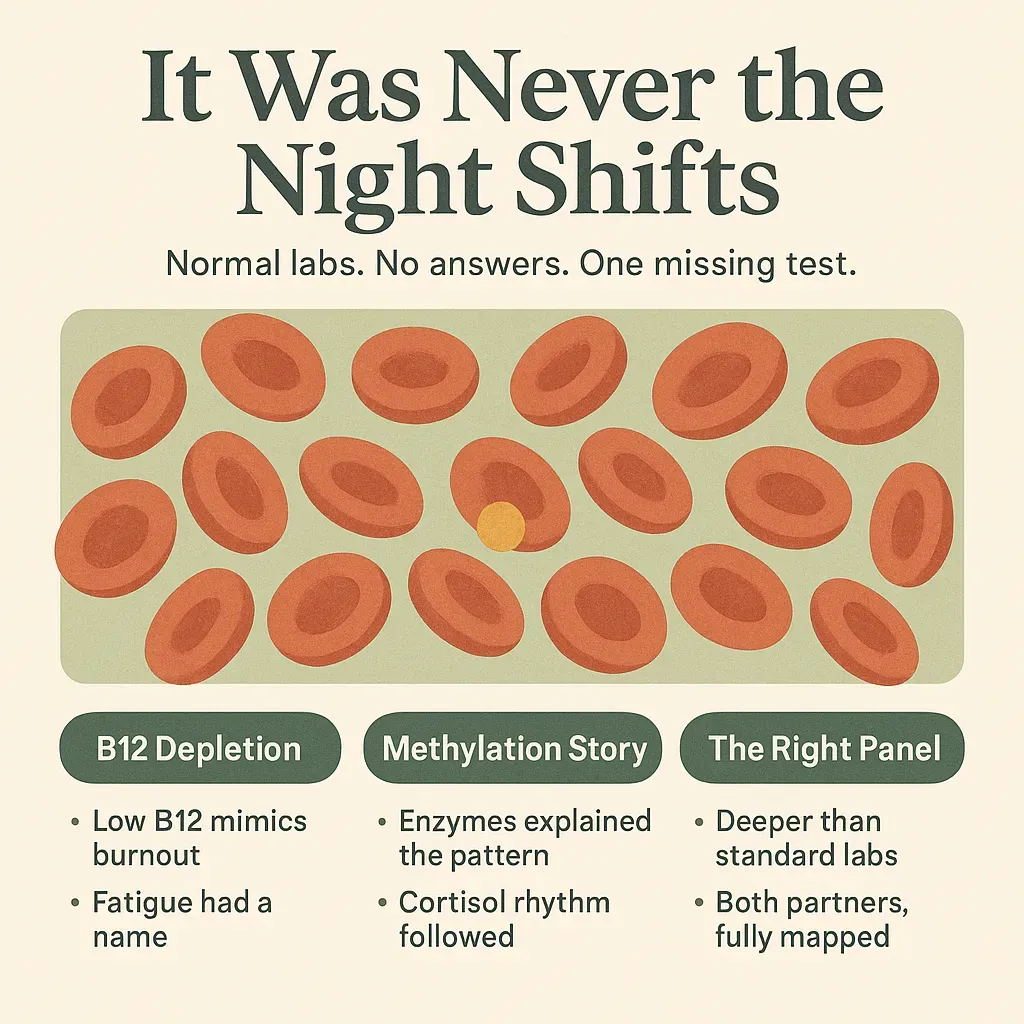
B12 Deficiency & Infertility: Flight Nurse Case Study
Clinical Review by Dr. Angela Sinnett, L.Ac
Camille had heard the same sentence from three different providers, in three different waiting rooms: "Your job is brutal on your body, of course your cycle is a mess." It sounded reasonable enough that she believed it for nine months, while a critical Vitamin B12 deficiency, a digestive enzyme insufficiency, low metabolized cortisol, impaired methylation, and low glutathione went untested underneath a diagnosis nobody bothered to investigate further. A 200+ biomarker panel finally found all five. Four months into a protocol built around them, Camille was pregnant. At 33, she was a flight nurse based in Tulsa, Oklahoma, and she was tired in a very specific way: not just the fatigue of rotating shifts and a body that never quite knew what time zone it was in, but the fatigue of being a careful, disciplined patient whose body kept refusing to cooperate no matter how clean her diet or how tightly she managed her routine. Her digestion swung unpredictably between diarrhea and constipation. Her blood sugar crashed through the afternoon, leaving her lightheaded and irritable despite eating the way a dietitian would approve of on paper. None of it fit neatly into "just the job," even though that was where every provider kept filing it.
Everyone Had the Same Explanation, and It Was Never Tested
Standard fertility workups look at a narrow slice of the hormonal picture, typically three or four markers pulled at one point in a cycle. For a woman whose real obstacle sits somewhere else entirely, a normal result on those three or four markers does not mean nothing is wrong. It means the test never looked in the right place.
Seed and Soil: Why "Normal" Labs Still Leave Women Stuck
Think of conception the way a farmer thinks about a growing season: the seed is the egg and the reproductive hormones involved in releasing and supporting it. The soil is everything else, digestion, nutrient absorption, adrenal rhythm, methylation, and the cellular systems that quietly determine whether a seed that looks perfectly viable actually has what it needs to take root and grow. Most conventional fertility care, and most well-meaning advice about diet and stress, focuses almost entirely on the seed. Is ovulation happening. Are the reproductive hormones in range. Is the uterine lining thick enough. Those are legitimate questions, and for many women they are the right questions. But for a woman like Camille, whose digestion could not reliably absorb the nutrients she was eating, whose stress hormone curve never rose the way it needed to at the right times of day, and whose cellular methylation machinery was running underpowered, the soil itself was depleted. A perfectly capable seed, planted in soil that cannot support it, does not get very far. No amount of additional focus on the seed alone was ever going to fix that. This is the piece that gets missed constantly in fertility care, and it is exactly the piece Strategic Fertility's 200+ biomarker panel exists to catch: not another look at the seed, but a genuine, detailed look at the soil.
The Diagnostic Blueprint: What 200+ Biomarkers Actually Uncovered
When Camille's full panel came back, five distinct findings explained what three years of "your job is stressful" never could. The first was a critical Vitamin B12 deficiency. B12 is not a minor supporting player. It is required for red blood cell formation, nervous system function, and the methylation cycle that governs how the body reads and expresses its own DNA, including the processes involved in egg development and early pregnancy support. A body running critically low on B12 is a body trying to run essential reproductive processes without one of their core inputs. The second was digestive enzyme insufficiency. This is the finding that explained the diarrhea-and-constipation cycle Camille had lived with for months. Without adequate digestive enzymes, food is never fully broken down, which means nutrients, including the B12 she was already short on, are poorly absorbed no matter how clean the diet feeding into the system actually is. Camille could have eaten a textbook-perfect diet and still ended up depleted, because the problem was never what she was eating. It was whether her body could actually extract what it needed from it. The third was low metabolized cortisol. Cortisol is often discussed only in terms of "too much stress," but a body can also under-produce or under-metabolize cortisol at the times it needs it most, particularly in shift workers whose sleep-wake cycle is constantly disrupted. A flattened or poorly metabolized cortisol rhythm affects far more than energy levels. It sits upstream of the entire hormonal cascade the reproductive system depends on for its own timing and signaling. The fourth was impaired methylation. Methylation is the biochemical process that turns nutrients like B12 and folate into usable forms the body can actually work with, and it also governs gene expression patterns relevant to fertility and early pregnancy. When methylation is impaired, even nutrients that do get absorbed may not get converted into a form the body can use, compounding the B12 deficiency rather than existing separately from it. The fifth was low glutathione. Glutathione is the body's primary internal antioxidant, responsible for protecting cells, including developing eggs, from oxidative stress. A body already under strain from disrupted sleep, an underpowered cortisol rhythm, and depleted B vitamin status has fewer resources available to keep that antioxidant defense running at the level reproductive cells need. Five findings, and every one of them connected. Poor enzyme function meant poor absorption. Poor absorption meant B12 depletion. B12 depletion meant impaired methylation. Impaired methylation and disrupted cortisol both drained the antioxidant reserves that glutathione was supposed to protect. None of this showed up as "infertility caused by a stressful job." It showed up as a body running five interlocking systems on far less than they needed, none of which a standard panel was ever built to catch. There was also an emotional turning point that completed her physical healing. The weekend right before her positive pregnancy test, Camille attended a retreat. In a follow-up call with our team, she shared that during those few days away, she finally surrendered the heavy emotional weight she had been carrying for years: the grief, the quiet sadness, and the constant mental exhaustion around her fertility. She gave birth to her beautiful and healthy baby boy at the end of July! If you want to see exactly how a 200+ biomarker panel uncovers findings like these, findings that standard testing was never designed to catch, Dr. Angela Sinnett walks through the full diagnostic process in a free masterclass. Watch it here. to see what your own labs might be missing.
The Four-Step Protocol: Rebuilding the Soil, One System at a Time
Camille's custom protocol was built directly around these five findings, in an order designed to let each step support the next. Step one addressed the digestive enzyme insufficiency first, with a broad-spectrum digestive enzyme protocol taken with meals. This was the foundation: without functioning digestion, no downstream nutrient repletion strategy was going to hold. Step two introduced high-potency sublingual B12, chosen specifically for its absorption route since Camille's gut was already known to be an unreliable pathway for nutrient uptake until enzyme function improved. Sublingual delivery let B12 bypass some of that early digestive bottleneck while the enzyme support caught up. Step three focused on adrenal rhythm support, working to restore a more functional cortisol curve across her shift-driven schedule rather than trying to force a conventional sleep pattern she could not realistically maintain in her line of work. Step four brought in targeted methylation optimization, giving her body the cofactors it needed to actually convert the B12 and other nutrients now being absorbed into usable, active forms, which in turn supported the glutathione and antioxidant systems that had been running depleted. Within weeks of starting the protocol, Camille noticed the digestive swings settling into something closer to predictable. The diarrhea-and-constipation cycle that had defined her days for months began to even out, and the blood sugar crashes that used to derail her afternoons became noticeably less frequent. That was the first sign, and it mattered on its own: a body that could finally absorb what she was feeding it, doing so consistently, for the first time in longer than she could remember. The real proof arrived later, in a season Camille had stopped letting herself plan around. Four months into her custom protocol, she got a positive pregnancy test. Not from a new procedure. Not from a different medication. From a body that had finally been given the specific inputs it had been missing the entire time: absorbable B12, functioning digestive enzymes, a supported cortisol rhythm, and the methylation and antioxidant capacity to put all of it to use. It is worth naming plainly what this case does and does not prove. Camille's five findings, the B12 deficiency, the enzyme insufficiency, the cortisol pattern, the methylation gap, and the glutathione depletion, are specific to her own biology, her own history, and her own results. A different woman with a different set of biomarkers could have an entirely different root cause, even if her symptoms look similar on the surface. This protocol was built for Camille's body, not as a template to apply to every case that resembles hers. That is the entire premise behind 200+ biomarker testing in the first place: finding what is actually true for one specific person, rather than assuming one explanation fits everyone with a demanding job and an unpredictable cycle.
5 Diagnostic Questions to Ask Before Your Next Procedure
Before agreeing to another round of testing, medication, or a procedure, these are the questions worth asking directly:
1. Has my B12 and full B vitamin status actually been measured, not assumed to be fine because I eat well?
2. Has anyone evaluated my digestive enzyme function, or only assumed that a clean diet automatically means good absorption?
3. Has my cortisol been measured at multiple points across the day, rather than as a single snapshot that cannot show a disrupted rhythm?
4. Has my methylation capacity been assessed, given how directly it affects whether the nutrients I take in are actually usable?
5. Has anyone looked at my antioxidant status, including glutathione, rather than treating oxidative stress as an assumption instead of a measurable finding? If the honest answer to more than one of these is no, the workup has not actually ruled out what might be happening. It has simply not looked yet.
Frequently Asked Questions
Can Vitamin B12 deficiency actually cause infertility?
Yes, in the sense that B12 is required for methylation, red blood cell production, and the broader cellular processes involved in egg development and early pregnancy support. A significant deficiency can disrupt those processes even when reproductive hormone levels themselves look normal on a standard panel. Why would someone with a clean diet still be nutrient deficient?
Diet quality only matters if the digestive system can actually absorb what is being eaten. Digestive enzyme insufficiency, gut inflammation, or other absorption issues can leave a person nutrient deficient regardless of how carefully they are eating, which is exactly what happened in this case. Does shift work actually cause infertility?
Shift work can disrupt the cortisol rhythm and sleep-wake cycle in ways that affect the broader hormonal system, but it is rarely the entire explanation on its own. Treating disrupted sleep as the full diagnosis, without testing what is actually happening at the biomarker level, can leave real, fixable findings unaddressed for years. What does a 200+ biomarker panel look at that a standard fertility workup does not?
A standard workup typically evaluates a small number of core reproductive hormones. A 200+ biomarker panel adds nutrient status, digestive function markers, cortisol patterns across the day, methylation capacity, and antioxidant reserves like glutathione, all of which can affect fertility even when the core reproductive hormones themselves appear unremarkable. How long does it typically take to see results from addressing root causes like these?
Every case is different, since the underlying findings and the body's response to correcting them both vary by person. In this case, digestive symptoms began improving within weeks, and pregnancy occurred four months into the custom protocol, but that timeline reflects this specific case rather than a guaranteed outcome for every patient. If your labs have come back normal and no one has been able to explain what is actually happening in your body, a $37 Discovery Call is the place to start. Book your Discovery Call here. and find out what a 200+ biomarker panel might reveal for you.